AI agents now shop for US users, so who handles a wrong buy?
This article reads official terms and documents from OpenAI, Google, Citi, PNC and the original PDF of the State Bank of Vietnam's Circular 53 to see how far ChatGPT Wallet and Gemini checkout let AI buy, and what the terms say about who handles a wrong purchase.
Illustrative scenario: someone asks an AI assistant to "buy a kettle under VND500,000". It picks the wrong model, or the seller refuses a return. The money is gone. Who bears the loss?
This article reads official documents and terms from OpenAI, Google, Citi and PNC, plus a TechCrunch report (November 18, 2026), checked on November 21, 2026. The Vietnam part uses the original PDF of Circular 53/2026/TT-NHNN (read by OCR) and Google help pages.
It answers 3 questions: how far the 2 new features of the past 2 weeks let AI buy (for now in the US), who handles each layer when a purchase goes wrong, and what sellers should prepare.
Key points
- ChatGPT Wallet (OpenAI, November 13, 2026) lets a "dot", OpenAI's always-on AI assistant, pay for the user. For now: ChatGPT Pro, US only, US-issued cards.
- Google's release note of November 17, 2026: Tasks in Gemini (a feature that gives Gemini background jobs) can buy through Google Pay once the user sets a maximum price, paying after the user confirms on the device. For now: US.
- When a purchase goes wrong, the terms push the work to the seller (orders, returns, refunds) and the card issuer (unfamiliar charges). OpenAI does not decide or fund refunds unless the law requires it or OpenAI promises otherwise; the user's approval covers only the details shown.
- Citi and PNC wrote terms about something else: giving a login password to a third-party AI agent. Citi treats the agent's actions as the customer's own; PNC bans sharing passwords and one-time codes and disclaims liability if an agent misunderstands.
- Vietnam: no official source shows these 2 features working there. Per the original PDF of Circular 53/2026/TT-NHNN (effective November 15, 2026), third-party AI used as a personal tool, not integrated into a covered entity's systems, is outside its scope.
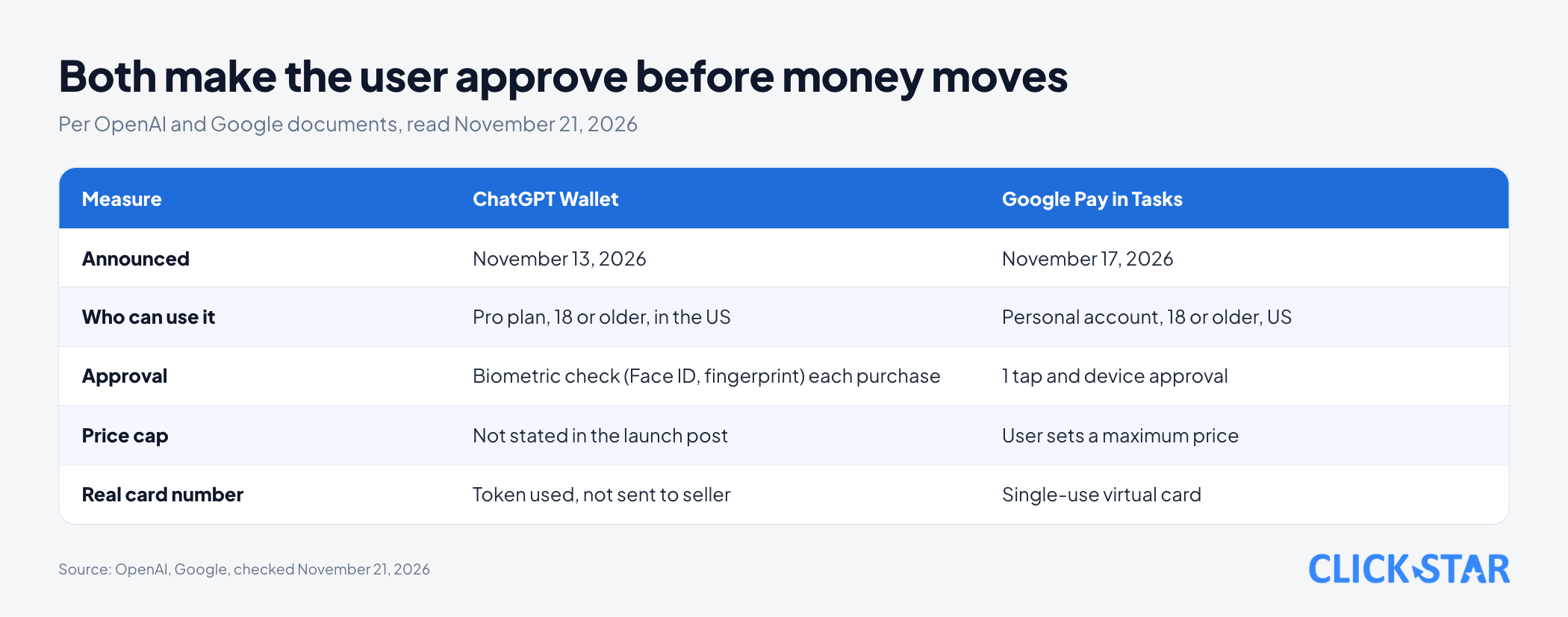
What is new in the past 2 weeks
The events fall on November 13 to 18, 2026, except dots (September 29).
ChatGPT Wallet: each purchase approved, real card hidden
Wallet runs only in a dot conversation, not in Chat, Work or standalone Codex threads (help page "Making purchases with ChatGPT Wallet", no specific date, read November 21, 2026). A dot is OpenAI's name for an always-on AI assistant, launched on September 29, 2026 (OpenAI's Introducing dots page).
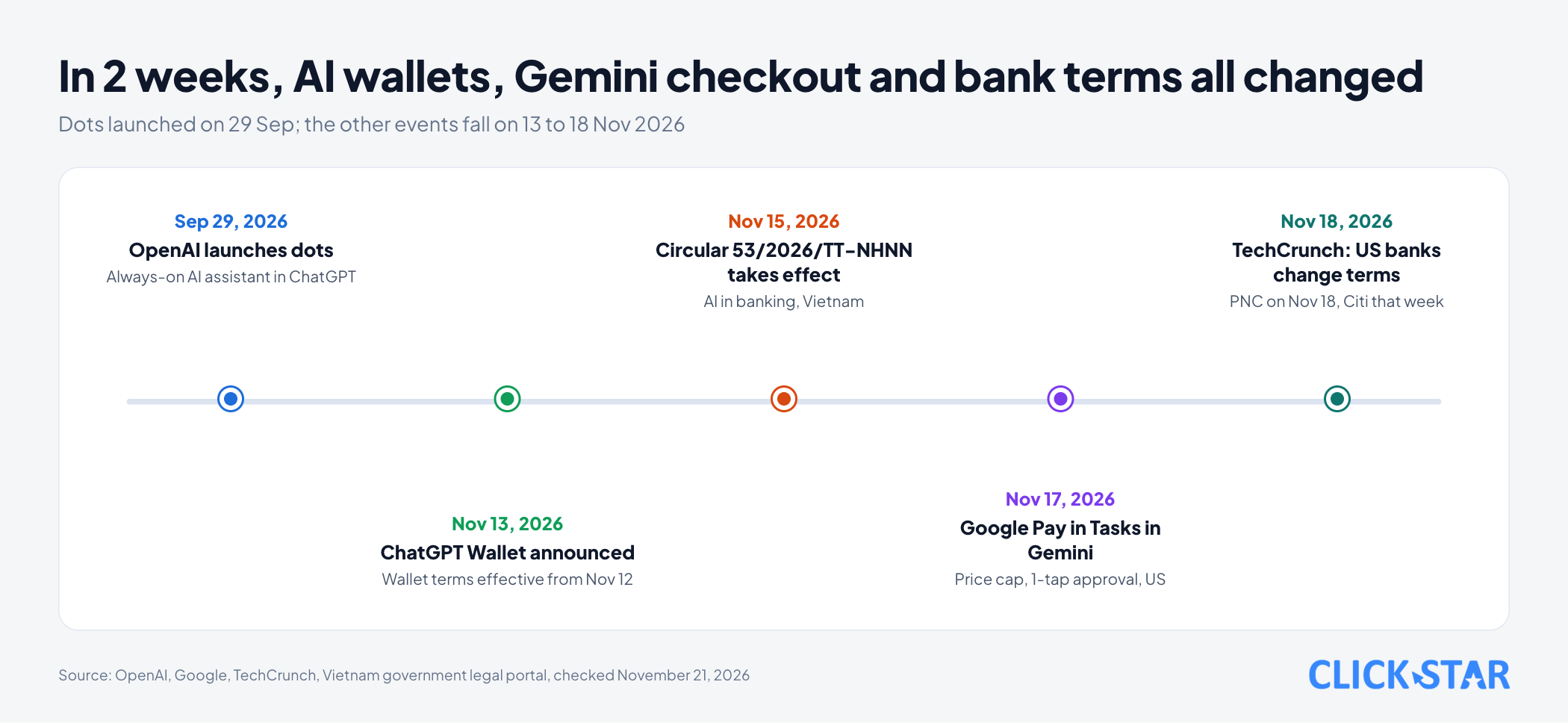
For each purchase, the dot shows the merchant, items, total and selected card. The user approves with a biometric check such as Face ID or a fingerprint. The card network then issues a token (a stand-in for the real card number), so the merchant and the dot do not receive the real number.
The help page notes "Ready to check out" only means your approval is complete, not that the merchant accepted the order. Look for the merchant's confirmation (receipt, order status or order confirmation) before buying again.
Google Pay in Tasks in Gemini: set a price cap, then approve
Per Gemini's release note of November 17, 2026, the user picks an item and a maximum price when creating a Task. When Gemini finds it within budget, it prepares checkout and sends an itemized summary.
The purchase proceeds only after the user gives 1 tap of confirmation and approves on the device. Google describes the payment as a single-use virtual card through Google Pay, so the merchant does not get the real number.
Google's blog of the same day says Gemini uses the Agent Payments Protocol (AP2), allows a "hard spending cap" upfront, and is designed to ask for confirmation or pre-approval before clicking Buy.
When a purchase goes wrong, who is responsible?
The terms split responsibility by layer: an error at approval, payment or in the order sends you to different parties.
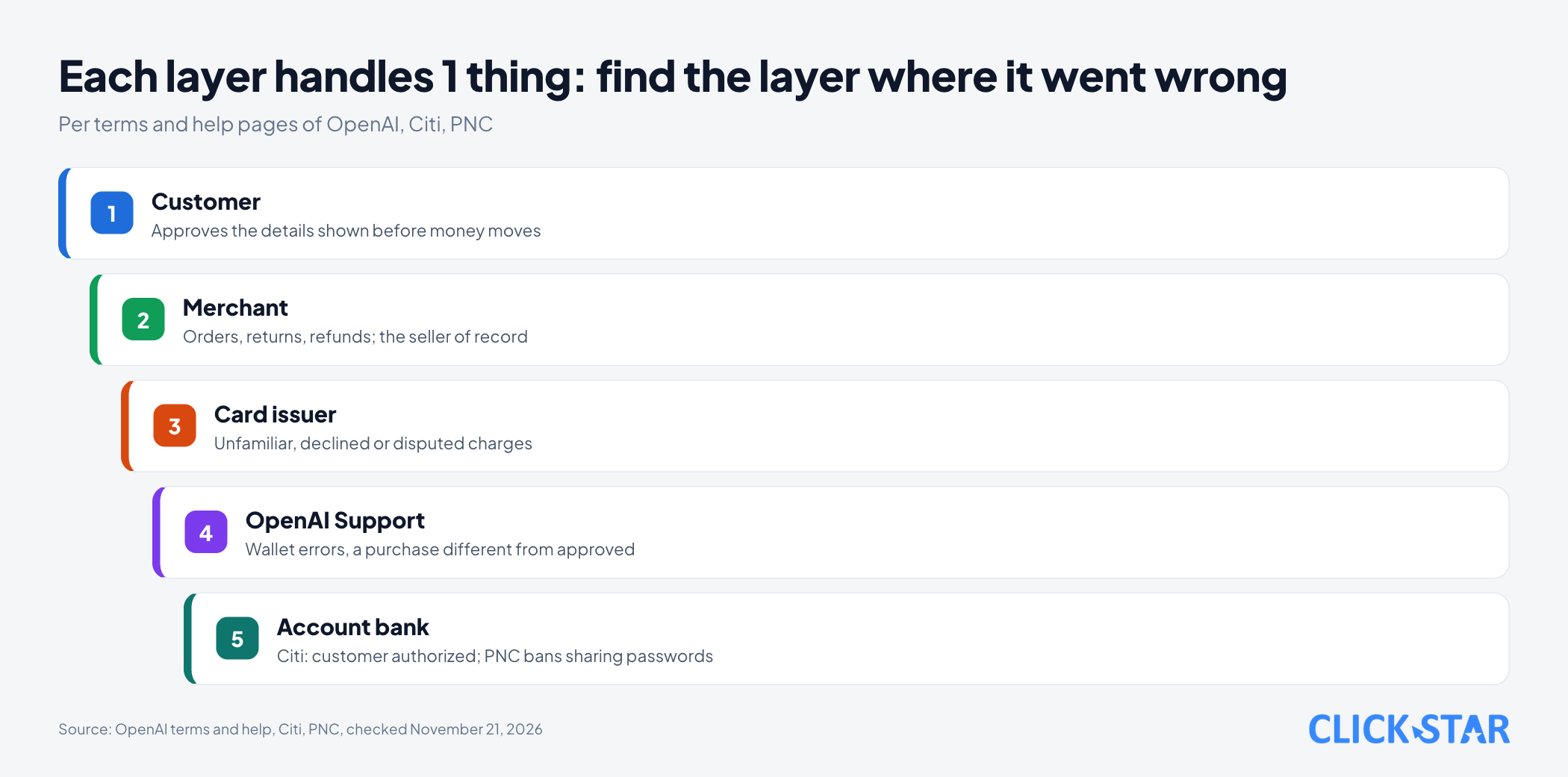
The Wallet terms (OpenAI, effective November 12, 2026) say approval is limited to the merchant, items, amount, card, recipient and terms shown. If a material detail changes, Wallet must ask again. The terms add that AI systems can make mistakes.
The merchant is the seller of record. OpenAI says it is not a bank, card issuer or merchant and assumes no liability for orders and payments; cardholder-agreement rights still apply.
On refunds, section 7 says order problems, returns and refunds go to the merchant; wrong or unauthorized charges to the card issuer. OpenAI may help with records but does not decide or fund merchant refunds or card chargebacks (reversals through the issuing bank) unless the law requires it or OpenAI separately promises otherwise.
OpenAI's help page adds: Wallet errors or a purchase different from what you approved go to OpenAI Support.
Google's page "About Agentic checkout with Google Pay" (no date, read November 21, 2026) says to contact the merchant if the wrong item was bought; if the price rises, the purchase does not go through. The page covers Agentic checkout in general; its top says US and Australia, its troubleshooting section says US only.
The article's inference, no official ruling behind it: the approval screen is the pivot. If the customer approved exactly what was shown, refunds run through the merchant or card issuer, not the AI platform.
US banks: do not give your password to an AI agent
TechCrunch (November 18, 2026) reports that Citi changed its terms that week and PNC on November 18.
The Citi Online User Agreement (read November 21, 2026, updated November 2026) has a new Section H. If a customer gives login credentials to a third-party AI agent, or lets it access accounts and make transactions, Citi treats the agent's actions as authorized by the customer, even if the credentials are later leaked.
PNC has a "Third-Party AI Agents" section in its Digital Services Agreement (the UPDATE file on pnc.com, read November 21, 2026 by decompressing the text from the PDF). It bans sharing IDs, passwords or one-time codes with agents, and bars agents from making payments for the customer unless PNC permits it.
PNC says it is not responsible if an agent misunderstands or does something unintended, unless the law requires otherwise; the customer answers for breaking those limits, as far as the law allows. The file's top gives effective date 12/19/2026 (December 19), unlike TechCrunch's November 18; the reason could not be checked.
These are 2 different matters: bank terms concern login access, while Wallet and Google Pay use tokens or virtual cards with approval of each purchase. The article's inference: risk falls most on whoever hands over the widest access, a password.
Vietnam: what exists and what does not
The Wallet terms require living and using it in the US; Google's release note of November 17, 2026 places Tasks purchasing in the US. The help page "Get help with your shopping in Gemini Apps" (no date, read November 21, 2026) lists Vietnam among countries for "shopping with Gemini Apps" but not which get the Buy button.
Circular 53/2026/TT-NHNN was issued on September 30, 2026. The article read the original PDF on the government legal portal (November 21, 2026) by OCR because its text layer is broken, so accents may be wrong. Not legal advice; check the original.
Under Article 1, clause 1, point c, services from third-party AI used as a personal tool, not integrated into the processes or information systems of an entity the circular covers (banks, payment institutions and others), fall outside it.
The article's inference: shopping agents customers use themselves are likely outside it; an agent a bank integrates is different.
For AI that pays automatically, deployed by a covered entity, Article 5, clause 1, point g requires a prior agreement with the customer (scope, per-transaction and daily limits, right to terminate), capped at VND100 million per day for individuals.
It took effect on November 15, 2026, with later dates (Articles 23 and 24): Article 14 from January 1, 2027; AI systems running before November 15, 2026 must comply from March 1, 2027; Article 6 (clause 1, point b) and Article 21 apply from September 1, 2027.
For sellers: what the documents say
The Accept payments page in OpenAI Developers (no date, read November 21, 2026) says Wallet works with existing checkout pages without separate integration. Sellers get a token instead of the card number, usable only for that transaction.
The launch post advises sellers to recognize Web Bot Auth signatures (a way of signing bot requests so a server knows which bot it is), publish product data with current price and stock, and ask their fraud provider how it spots agent orders.
The article's inference: an order placed by an agent is still your order, with full duties on delivery, returns and fraud control. If possible, flag these orders in reports.
Where the sources differ
There are 3 points to read carefully.
- Pre-approval: the launch post says delegating purchases to the agent within limits is something OpenAI expects "over time". The terms already leave room for it; no document found says it is on.
- Whether Gemini buys on its own: Google's blog mentions "confirmation or pre-approval" and "Always allow" (its example is adding to a cart); the release note for Tasks mentions only 1-tap approval. A Scalevise write-up (secondary, no date, read November 21, 2026) says a mode buys within a limit. No Google page says clearly whether Tasks has it.
- Where it applies: the release note says US; Google Pay's "About Agentic checkout" says US and Australia (its troubleshooting section says US); the Merchant Center page on the Buy button (no date, read November 21, 2026) says US, Canada, Australia and "soon".
What to watch
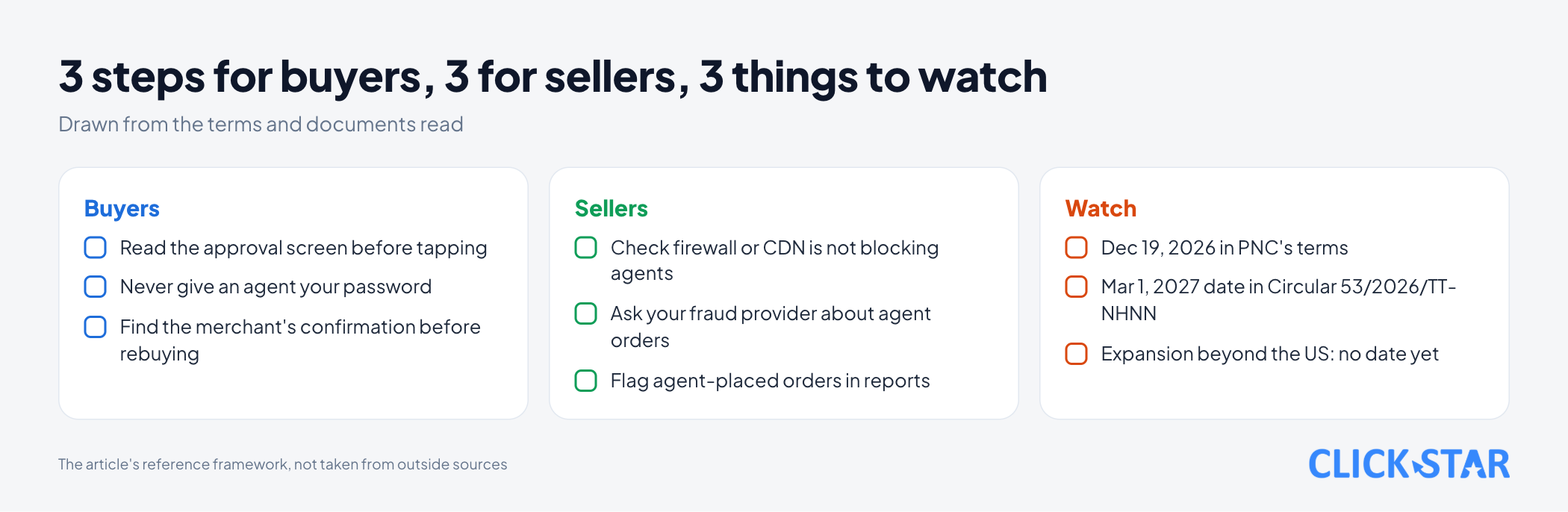
- This week, when trying it: read the approval screen (merchant, item, total, card) before tapping, since OpenAI says approval covers only those details.
- This week, if you sell goods: check whether your firewall or CDN (the server network in front of a website) blocks agent signatures by mistake, and ask your fraud provider how it recognizes agent orders.
- For bank accounts: do not give passwords or one-time codes to a third-party AI agent, and read your bank's matching terms; the article has no Vietnamese bank terms.
- Upcoming dates: December 19, 2026 is the date at the top of PNC's terms (check it on PNC's site); March 1, 2027 is Circular 53/2026/TT-NHNN's date for AI systems already running. No date for expansion beyond the US.
Common mistakes
- Treating everything called "AI buying" as one thing. Paying by token with per-purchase approval is very different from giving a bank password to an agent.
- Tapping approve without reading the summary. The approval covers only the details shown; by the article's inference, an error there is hard to blame on the AI.
- Reading "Ready to check out" as an order placed. OpenAI advises checking the merchant's confirmation before trying again.
- Applying US bank terms to Vietnamese banks. This article has not read the terms of any bank in Vietnam.
What is not known
There is no measure of how often agents buy wrongly or how many people use Wallet in the documents read. No ruling or regulatory guidance was found on who pays when an AI agent buys the wrong thing; consumerfinance.gov returned an access-denied error to the tool, so it was not read and not worked around.
When these features will open outside the US is unknown, and no Vietnamese bank terms on AI agents were found in the sources opened. It is unclear how the circular applies to an agent that a Vietnamese bank integrates into its own systems.
Related posts

Need tailored advice for your business?
Click Star helps you build a solution that fits your industry and scale. We answer every question during business hours.